

Workplace & Organisational Wellbeing Systems
Build a workplace where people and organisations can thrive.
Staff disengagement, retention challenges, workplace pressures and fragmented support systems rarely have one simple cause. Sustainable improvement begins with understanding the conditions shaping people's experiences at work.
The Whole of Organisation Universal Wellbeing System provides a structured, research-informed approach to developing Universal Wellbeing capability and coordinating support across an organisation. It applies primordial prevention by examining underlying determinants, rather than only responding once problems arise.
The challenges organisations face
Move beyond isolated wellbeing initiatives.
Workplace challenges are often connected. A whole-of-organisation approach helps leaders consider the underlying factors influencing people, systems and outcomes.
Engagement and retention
Consider the conditions influencing staff experience, participation, morale and the ability to remain engaged at work.
Disconnected responses
Develop clearer ways to coordinate wellbeing responsibilities, professional capability and appropriate support.
Long-term improvement
Look beyond short-term activities to understand the organisational determinants that can influence sustained outcomes.
The whole-of-organisation approach
How the Universal Wellbeing System works
The system combines an organisational implementation pathway with professional education and accreditation options that support staff to develop and apply Universal Wellbeing capabilities.

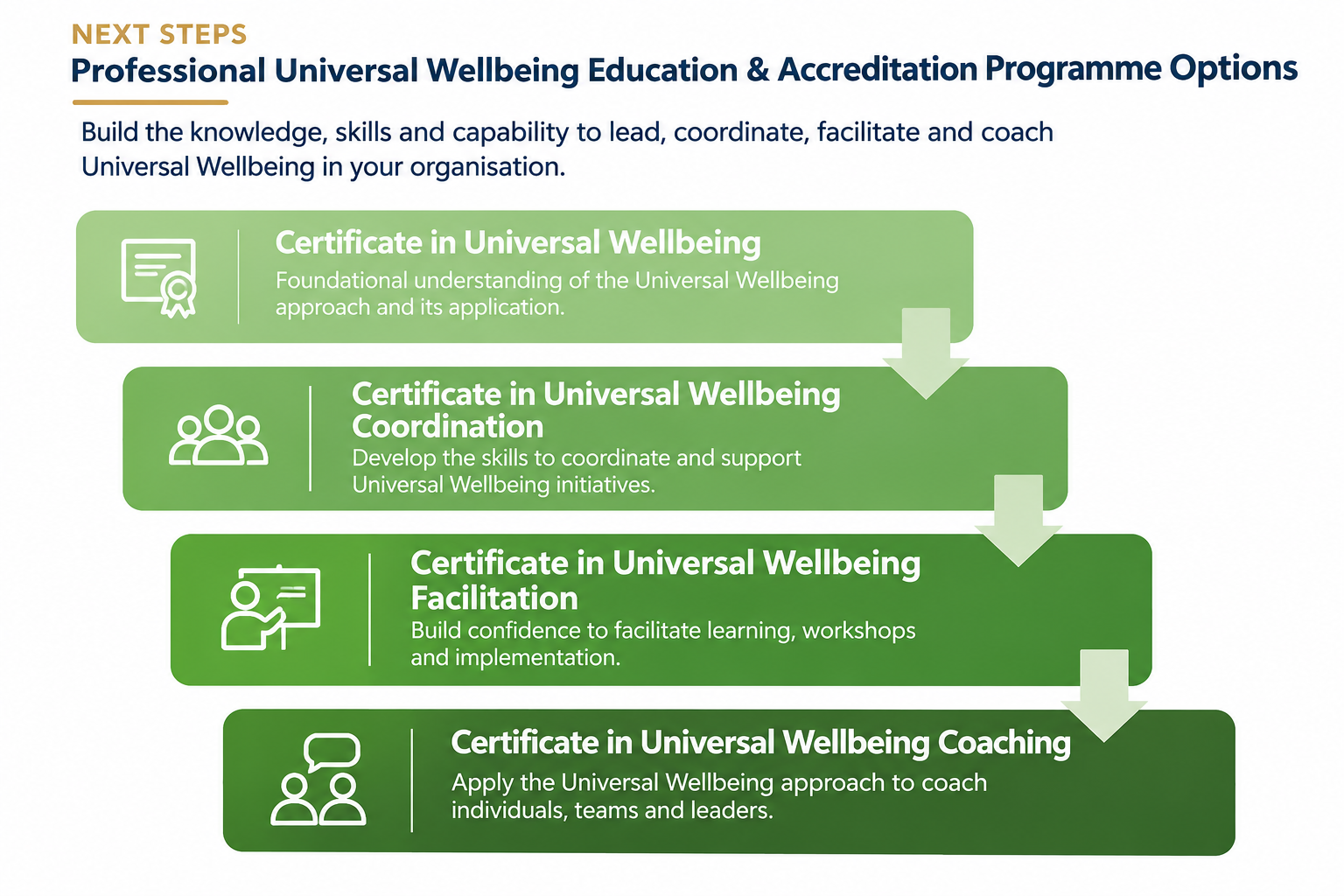
Programme suitability and implementation arrangements can be discussed with the FREEDOM Wellbeing Institute.
Implementation pathway
From understanding to sustained improvement
Organisations can develop a coordinated approach through a practical sequence of learning, capability building and review.
Understand
Introduce staff to the Whole of Organisation Universal Wellbeing Model through a workshop.
Build capability
Identify appropriate staff roles and professional education options to support implementation.
Coordinate support
Develop coordinated responsibilities and connections to appropriate expert support.
Review and improve
Consider progress, evaluate outcomes and refine the approach over time.
Research-informed foundations
Addressing determinants, not just symptoms.
FWI's Universal Wellbeing approach draws on more than 17 years of applied research. It examines the conditions that influence wellbeing and supports a primordial prevention approach to organisational development.